You’ve likely felt the pull toward a workspace that doesn’t scream for attention — where pale wood, soft light, and clean lines create a backdrop for deep focus. That’s the gift of a japandi home office. Blending Japanese minimalism (with its embrace of imperfection and natural materials) and Scandinavian coziness (warmth, texture, and functionality), this style turns a desk and chair into a sanctuary. Think of a rice paper lantern casting a gentle glow, a wooden desk with visible grain, a single branch in a ceramic vase. You’ll love how a japandi home office reduces clutter to almost nothing, yet feels warmer than any stark modernist space.
From desks paired with low bookshelves to rooms filled with plants and natural light, from wood-paneled ceilings to green accent walls, this collection celebrates the art of working without overwhelm. Japandi home office ideas prove that you don’t need a large room to have a peaceful, productive workspace — you need intentionality. Let’s explore offices where every object earns its place and every corner invites you to sit and create.
1. Home Office With Desk, Chair, and Bookshelf — All in a Row, All in Harmony
Arrange a simple wooden desk, a comfortable task chair, and a low bookshelf in a straight line against a wall. The bookshelf holds a few books, a small plant, and a ceramic bowl. In a japandi home office, less is always more. You’ll love how the pale wood of the desk matches the shelf, and how the chair’s neutral fabric blends with the wall. A single piece of art — an abstract in muted earth tones — hangs above the desk.
The floor is light oak, and a small rug defines the workspace. Japandi home office design proves that you don’t need a large room; you need a few well-chosen pieces. This pin teaches that alignment and repetition create calm.
2. Desk, Two Chairs, and a Book Shelf in the Corner — A Workspace for Two
Create a shared workspace with a long desk, two simple chairs, and a corner bookshelf. The bookshelf is open, displaying a few books and a small stack of notebooks. In a japandi home office, symmetry can accommodate two people. You’ll appreciate how each side of the desk has its own small lamp, and how the chairs are identical but not imposing. The walls are a soft warm white, and a single plant sits in the corner.
The floor is pale wood, and a simple pendant light hangs above the desk. Japandi home office design for two proves that shared spaces can still be serene. This pin shows that symmetry doesn’t have to be cold — it can be grounding.
3. Room With Desk, Chair, and Shelves on the Wall Next to It — Vertical Calm
Mount two floating shelves on the wall beside the desk. They hold a small plant, a candle, and a few favorite books. The desk is simple and low, the chair is an ergonomic but unobtrusive design. In a japandi home office, vertical storage keeps the desktop clear. You’ll love how the shelves are painted the same color as the wall, almost invisible. The desk faces a window with sheer curtains that diffuse the light.
A woven rug lies under the desk, adding texture. Japandi home office ideas often use floating shelves to keep the floor clear. This pin proves that a small wall can hold everything you need.
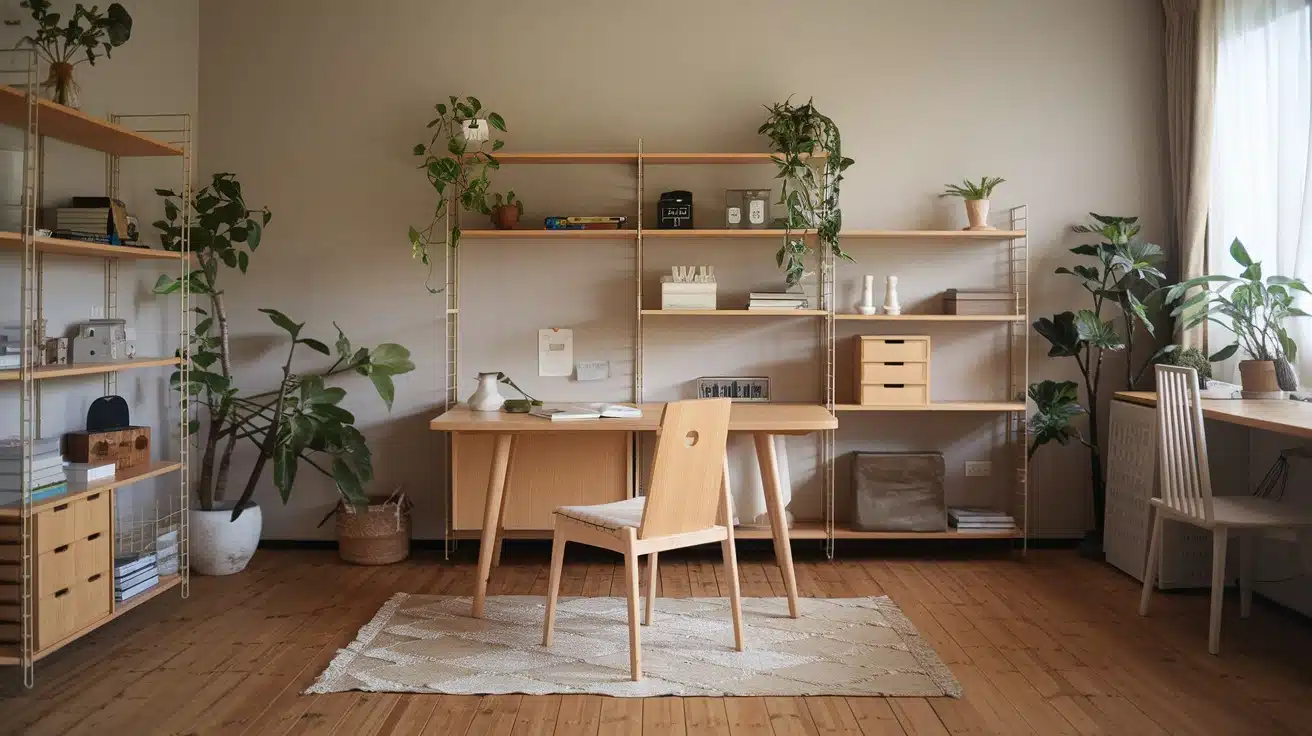
4. Home Office With Wooden Shelves, Plants, and a Desk — A Living Workspace
Fill your office with wooden shelves lined with plants — pothos, snake plant, a small fern. The desk is a warm walnut, and the chair is a soft gray. In a japandi home office, plants are not decorations; they’re living sculptures. You’ll appreciate how the green against the pale wood creates a palette that’s both energizing and calming. A small paper lantern hangs above the desk, casting a soft glow.
The floor is a light beige tile, and a simple woven blind covers the window. Japandi home office with plants feels alive and breathing. This pin shows that a workspace can be a greenhouse of ideas.
5. Home Office With Wood-Paneled Ceiling — Open, Airy, and Grounded
Look up at the wood-paneled ceiling in this home office — narrow planks of pale cedar, running the length of the room. The walls are white, the desk is simple and low. In a japandi home office, a wood ceiling adds warmth without clutter. You’ll love how the ceiling draws the eye up, making the room feel larger. A single pendant light hangs low over the desk, its shade made of rice paper.
The floor is concrete, softened by a jute rug. Japandi home office with a wood-paneled ceiling proves that architectural details can be the decoration. This pin is for those who can add a ceiling treatment — it’s worth the investment.
6. Home Office With Built-In Shelving and a Desk — Seamless and Custom
Install built-in shelving that surrounds the desk — floor-to-ceiling on both sides, with the desk floating between them. The shelves hold only a few items: a stack of notebooks, a small plant, a ceramic bowl. In a japandi home office, built-ins eliminate freestanding furniture, creating a seamless look. You’ll appreciate how the shelves are painted the same white as the walls, almost disappearing. The desk is a pale wood, matching the floor.
A simple task chair sits at the desk, its fabric a soft gray. Japandi home office with built-ins is perfect for small spaces. This pin proves that custom storage can look like architecture, not furniture.
7. Desk, Chair, Lamp, and Vase in Front — A Minimalist Still Life
Arrange a desk with just four items: a laptop, a small lamp, a ceramic vase with a single branch, and a simple chair. The desktop is otherwise clear. In a japandi home office, empty space is not wasted — it’s essential. You’ll love how the lamp’s warm glow highlights the branch’s silhouette. The wall behind is a soft cream, and a small painting hangs above the desk — an abstract in muted earth tones.
The floor is pale wood, and a simple rug lies under the chair. Japandi home office at its most minimal proves that you need almost nothing to work well. This pin is a meditation on enough.
8. Desk With a Laptop on Top, and a Book in Front — The Essentials Only
Work with just a laptop and a single book on your desk — perhaps a notebook or a favorite novel for breaks. The desk is a pale oak, the chair is a simple wooden design with a cushion. In a japandi home office, digital and analog live side by side. You’ll appreciate how the laptop’s screen is the only source of technology in view. A small plant sits on the windowsill behind the desk, visible but not intrusive.
The walls are white, the floor is light wood. Japandi home office at its most functional reminds us that a workspace should serve work, not the other way around. This pin encourages you to clear your desk and see what’s truly necessary.
9. Home Office With Wooden Shelves and a Gray Chair — Soft Contrast
Combine warm wooden shelves with a soft gray task chair. The shelves are open, holding a few books and a ceramic pot. The desk is the same pale wood as the shelves, creating a unified look. In a japandi home office, gray is a neutral that doesn’t compete with wood. You’ll love how the chair’s fabric is a heathered gray, adding subtle texture. A small lamp on the desk has a linen shade.
The walls are a warm white, and a simple rug lies under the desk. Japandi home office with gray and wood feels both modern and timeless. This pin proves that you can have a soft, approachable workspace without clutter.
10. Living Room Filled With Furniture and Decor — But the Office Nook Is Serene
Create a dedicated office nook within a larger living room. A small desk fits into an alcove, with a single shelf above holding a plant and a candle. The rest of the living room is filled with furniture, but the nook remains sparse. In a japandi home office, even a corner can become a workspace. You’ll appreciate how a folding screen or a large plant can visually separate the nook from the rest of the room.
The desk is pale wood, the chair is a simple bentwood design. Japandi home office in a shared space proves that you don’t need a dedicated room. This pin shows that a small, intentional corner can be as productive as an entire study.
11. Home Office With Green Walls and Wooden Shelves — Earthy and Deep
Paint the walls a soft, muted sage green — the color of a forest floor. The desk and shelves are pale oak, providing contrast. In a japandi home office, green walls add depth without being distracting. You’ll love how the green recedes, making the room feel larger, and how the wood seems to glow against it. The desk holds only a laptop, a small lamp, and a tiny ceramic vase with a single dried branch.
The floor is a light beige tile, and a jute rug adds texture. Japandi home office with green walls feels like working inside a peaceful garden. This pin proves that color can be moody and serene at the same time.
12. Living Room Filled With Furniture Next to a Large Window — The Desk by the Light
Place your desk near a large window, even if the rest of the room is full of living room furniture. The desk is small, a simple wooden slab on hairpin legs. In a japandi home office, natural light is your most important tool. You’ll appreciate how the window faces north, providing consistent, soft light all day. The chair is a simple wooden design with a woven seat.
A single plant sits on the windowsill, and a small lamp provides warm light in the evening. Japandi home office by a window proves that you don’t need a separate room — just good light and a simple desk.
13. Desk With a Laptop on Top, and a Bookcase in Front — A View of Your Library
Face your desk toward a low bookcase, so that when you look up from your laptop, you see the spines of your favorite books. The bookcase is simple, pale wood, with open shelves. In a japandi home office, facing a bookcase instead of a wall adds visual interest without distraction. You’ll love how the books are a mix of colors but are muted — mostly earth tones. The desk holds only the laptop, a small lamp, and a single notebook.
The chair is a comfortable task chair in a soft gray. Japandi home office with a bookcase view proves that what you see when you look up matters. This pin encourages you to arrange your desk to face something beautiful.
14. Desk With a Computer on Top, and a Bookcase in Front — Digital Meets Analog
Work with a computer on your desk, but keep a small stack of reference books on a shelf just above the monitor. The desk is a pale oak, the chair is a simple wooden design. In a japandi home office, technology and tradition coexist. You’ll appreciate how the books are within arm’s reach but not cluttering the desk. A small plant sits on the corner of the desk, softening the technology.
The walls are a soft cream, and a simple pendant light hangs above. Japandi home office with computer and books proves that you can have both — just keep the screen clean and the books organized.
15. Home Office With Wooden Floors and White Walls — The Classic Japandi Palette
Embrace the classic Japandi palette: white walls, pale wood floors, and simple furniture. The desk is a floating slab attached to the wall, with no visible legs. The chair is a simple bentwood design. In a japandi home office, the absence of clutter is the decoration. You’ll love how the white walls reflect light, making the room feel larger. A single piece of art — a Japanese woodblock print in muted tones — hangs above the desk.
A small plant sits on the desk, and a woven rug lies under the chair. Japandi home office at its purest proves that you need almost nothing to have a beautiful workspace. This pin is a lesson in restraint.
16. Office With Bookshelves and a Desk in Front of a Window — Light and Literature
Position your desk directly in front of a window, with low bookshelves on either side. The window provides natural light, and the bookshelves frame your view. In a japandi home office, symmetry and nature work together. You’ll appreciate how the desk is simple — just a wooden slab — and how the chair is a comfortable but minimal design. The bookshelves hold a few books, a plant, and a small ceramic collection.
The walls are a soft warm white, and the floor is pale oak. Japandi home office with a window as a focal point proves that the best art is the outdoors. This pin encourages you to arrange your workspace around your best view.
17. Home Office With Wooden Shelves, Plants, and a Wall — A Vertical Garden of Calm
Cover one wall with wooden shelves of varying heights, and fill them with plants — trailing pothos, small ferns, a snake plant. The desk sits perpendicular to this living wall. In a japandi home office, a green wall improves air quality and mood. You’ll love how the plants soften the room’s angles and provide a natural screen. The desk is simple, pale wood, and the chair is a soft gray.
The opposite wall is white, and a single piece of art hangs there. Japandi home office with a plant wall proves that you can bring the outdoors in, even in a small space. This pin is for plant lovers who also need to work.
18. Japandi & Plants — A Dedicated Pin to the Fusion of Styles
Celebrate the fusion of Japandi style and plant love in this dedicated pin. A low wooden desk sits against a pale wall, with a simple chair. Above the desk, a shelf holds a trailing pothos and a small ceramic pot. In a japandi home office, plants are not afterthoughts — they are essential. You’ll appreciate how the green vines soften the desk’s straight lines. A paper lantern hangs from the ceiling, casting a warm glow.
The floor is light wood, and a woven rug adds texture. Japandi home office with plants proves that a workspace can feel like a greenhouse — calm, fresh, and full of life. This pin is a reminder to add green to every workspace.
19. Home Office With Plants and a Desk — A Simple, Green Sanctuary
Place a small desk in a corner, and surround it with plants on the floor, on shelves, and hanging from the ceiling. The desk holds only a laptop and a small lamp. In a japandi home office, the plants become the architecture. You’ll love how the green creates a sense of enclosure without walls. The chair is a simple wooden design, and a small rug defines the workspace.
The walls are white, allowing the plants to pop. Japandi home office with abundant plants proves that you can work in a jungle and still be productive. This pin is for those who want their office to feel like a retreat.
20. Desk With a Computer on Top, in Front of a Window — The Ultimate View
Position your desk so that when you look up from your computer, you see a window — ideally with a tree or sky visible. The desk is simple, the chair is comfortable. In a japandi home office, the view is part of the design. You’ll appreciate how the window is left unadorned or has only sheer curtains. The desk holds only the computer, a small plant, and a single pen.
The walls are a soft cream, and the floor is pale wood. Japandi home office with a window view proves that the best decor is outside. This pin encourages you to face your desk toward whatever brings you peace.
21. Desk With a Computer and a Book Shelf in Front — A Workspace With Depth
Face your desk toward a low bookcase that holds your reference books, a small plant, and a few personal items. The bookcase is open, so the spines become a textured backdrop. In a japandi home office, a bookcase can serve as a headboard for your desk. You’ll love how the books are arranged by color — muted earth tones only. The desk holds a computer, a small lamp, and a ceramic cup for pens.
The chair is a simple task chair in a soft gray. Japandi home office with a bookcase view proves that what you see when you work matters — make it beautiful.
22. Desk With a Computer and a Chair Next to It — The Bare Essentials
Work with just a computer on a simple desk, and a comfortable chair beside it. No books, no plants, no lamp — just the essentials. In a japandi home office, the ultimate luxury is empty space. You’ll appreciate how the desk’s pale wood and the chair’s soft gray are the only colors in the room. The walls are white, the floor is light oak, and a single piece of art — a black ink brushstroke — hangs above the desk.
The window is large, providing natural light. Japandi home office at its most minimal proves that a workspace can be a meditation. This final pin is a reminder that sometimes the best thing you can add is nothing at all.
🎋 Bamboo & Breath Guide: 7 Pillars of a Serene Japandi Home Office
- 🪵 Choose Furniture With Visible Grain: In a japandi home office, wood should look like wood — not painted, not heavily stained. Pale oak, walnut, bamboo, and teak are ideal. The grain is the decoration. Avoid anything with a high-gloss finish; look for matte, natural, or oiled surfaces.
- 💡 Layer Your Light, but Keep It Soft: Use at least two light sources: a task lamp for the desk and ambient light from a pendant or floor lamp. In japandi home office, choose paper lanterns, linen shades, or rice paper lamps. The light should be warm (2700K) and diffused — never harsh or direct.
- 🌿 Add One Living Thing per 50 Square Feet: A small plant on the desk, a fern on a shelf, a snake plant in the corner. In a japandi home office, plants clean the air and soften the space. Choose low-maintenance varieties: pothos, ZZ plant, snake plant, or a bonsai for a focal point.
- 📦 Hide Everything That Doesn’t Need to Be Seen: Use cabinets, drawers, or baskets to store papers, cables, and office supplies. In a japandi home office, a clear desk is a clear mind. If you can’t hide it, edit it. Do you really need that third notebook? That extra pen?
- 🎨 Stick to a Palette of 3–4 Earth Tones: Pale wood, warm white or soft beige, muted gray or sage green, and a single accent (perhaps black ink or a touch of terracotta). In japandi home office, color should be quiet, never shouting. Think of a landscape: sky, soil, leaves, stone.
- 🖼️ Hang One Piece of Art — Just One: Choose a single, meaningful piece: a Japanese woodblock print, an abstract ink wash, a black-and-white photograph. In japandi home office, art is not a gallery; it’s a focal point. Hang it at eye level and give it room to breathe.
- 🧹 Clean Your Desk at the End of Every Day: In Japandi philosophy, the state of your space reflects the state of your mind. A japandi home office requires daily maintenance: put away papers, wipe the desk, fluff the cushion, water the plant. Starting each day with a clean space is a ritual of respect for your work.
Frequently Asked Questions
Q: What’s the difference between Japandi and minimalism in a home office?
Ans: Minimalism can feel cold and stark — white walls, bare surfaces, no warmth. A japandi home office, on the other hand, adds warmth through natural materials (wood, bamboo, linen), soft lighting, and organic shapes. It’s minimal but cozy. Think of a minimalist room as an empty gallery; a Japandi room is a cabin in the woods — simple, but never cold.
Q: How do I make a small home office feel Japandi without a renovation?
Ans: Focus on three things: a natural wood desk, a soft light source (paper lantern or linen-shaded lamp), and a single plant. Remove everything else. In a japandi home office, subtraction is your best tool. Also, add a woven rug or a bamboo blind to bring in natural texture. You don’t need new walls — you need less stuff.
Q: Can a Japandi home office be colorful?
Ans: Yes, but the colors should be muted, like a foggy morning. Sage green, dusty blue, warm terracotta, or a soft ochre are all acceptable in a japandi home office. The key is that the color should feel like it comes from nature — not neon or bright. Use color on one accent wall or in accessories (a ceramic vase, a throw blanket), not everywhere.
Q: What’s the best chair for a Japandi home office?
Ans: Look for a chair that balances ergonomics and aesthetics. In a japandi home office, avoid bulky gaming chairs or glossy executive designs. Instead, choose a wooden task chair with a woven seat (like a Thonet or a modern reproduction), or a simple upholstered chair in a natural fiber like linen or wool. If you need ergonomic support, look for a chair with clean lines and muted colors — gray, cream, or charcoal.
Q: How do I handle cord management in a Japandi home office?
Ans: Cords are the enemy of serenity. In a japandi home office, use a cord tray under the desk, run cords along the back of table legs, and use cable clips painted to match the wall. If possible, position the desk so cords drop behind a cabinet or a plant. A wireless keyboard and mouse also help. The goal is to see no cords from your seated position — they disrupt the visual calm.
Conclusion
You’ve wandered through twenty-two workspaces where pale wood meets soft light, where a single branch in a vase is enough decoration, where plants and books live in quiet harmony. A japandi home office is not a style you buy; it’s a practice you adopt. It’s choosing a clear desk over a cluttered one. It’s editing your belongings until only the essential remains. It’s letting the grain of the wood and the path of the sun be your decorations. In a world that constantly demands more, the Japandi office asks: what can you remove? And the answer is almost always — more than you think.
Now it’s your turn to simplify. Clear your desk completely. Put away everything that isn’t for today’s task. Bring in one small plant and one soft lamp. If you have a window, face it. If you don’t, hang a single piece of art that makes you exhale. In a japandi home office, you don’t need to buy new things — you need to see what you already have with fresh eyes. So sit down, take a breath, and begin. Your calmest, most creative work is waiting. 🎋